Royalty rates for e-book authors play a pivotal role in determining the financial success of their literary endeavors. Delving into this topic reveals the intricate world of publishing, where authors navigate various agreements and structures that influence their earnings. Whether you are a seasoned author or just starting out, understanding the dynamics of royalty rates can be the key to maximizing your profits.
From the different royalty structures to the impact of pricing and publisher agreements, this discussion will shed light on the factors that shape an author’s income. We’ll explore how self-publishing compares to traditional publishing and present tools that can help authors track their sales and payments, ensuring they make informed decisions throughout their writing journey.
Royalty Rates Overview
The journey of an e-book author often hinges on understanding the intricacies of royalty rates. These rates determine how much money an author earns from their work, which can significantly impact the sustainability of their writing career. In this overview, we will explore the various royalty structures available to e-book authors, the influence of publisher agreements, and the industry standards for royalty percentages.The royalty structure for e-book authors can vary widely depending on whether they publish independently or through traditional publishing houses.
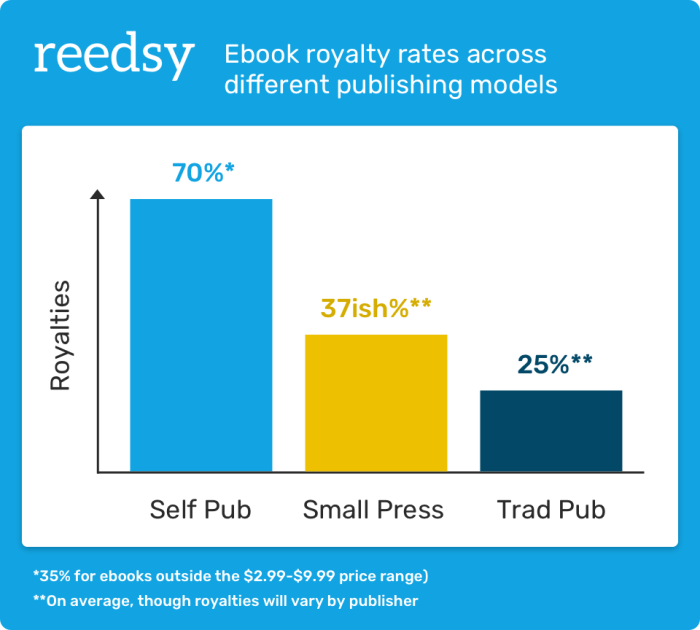
Typically, royalties are expressed as a percentage of the book’s sales price or net revenue. Independent authors generally benefit from higher royalty rates, often ranging from 35% to 70%, depending on the distribution platform. In contrast, traditional publishers may offer lower percentages, usually between 10% and 25%, after expenses like production and marketing costs are subtracted.
Royalty Structures for E-Book Authors
Understanding the different royalty structures is essential for authors aiming to maximize their earnings. Here are the most common structures:
- Flat Percentage Royalties: Authors receive a fixed percentage of the sale price. For example, a 70% royalty on a $10 e-book results in $7 for the author.
- Tiered Royalties: Earnings increase with sales thresholds. For instance, an author might earn 25% for the first 1,000 copies sold, then 30% for sales between 1,001 and 5,000 copies.
- Advances Against Royalties: Authors receive an upfront payment, which is recouped from future royalties. This can provide financial security but may lead to lower overall earnings until the advance is covered.
The agreements authors sign with publishers play a crucial role in determining their royalty rates. Publishers often negotiate terms based on the author’s marketability, previous sales performance, and the anticipated success of the book. It’s not uncommon for authors to find themselves in contracts that include clauses affecting their royalties based on factors like geographical sales, format (e-book versus print), and distribution channels.
Industry Standards for Royalty Percentages
While royalty rates can differ greatly, certain benchmarks have emerged within the industry. These standards can serve as a reference for authors evaluating their agreements:
- Self-Publishing Platforms: Authors using platforms like Amazon Kindle Direct Publishing (KDP) typically see royalties of 70% for e-books priced between $2.99 and $9.99. For books priced outside this range, the royalty rate drops to 35%.
- Traditional Publishing: According to industry norms, debut authors may expect royalties of around 10% to 15% on print sales and about 25% to 30% for e-books. Established authors can negotiate higher percentages.
- Hybrid Publishing: Authors working with hybrid publishers, who offer services between traditional and self-publishing models, often retain a higher percentage of royalties than with traditional publishing, typically around 40% to 50%.
Authors should always read the terms carefully and understand how various factors can affect their royalties. As the e-book market continues to evolve, staying informed about trends and changes in royalty structures will empower authors to make educated decisions regarding their publishing paths.
Factors Influencing Royalty Rates
Understanding the factors that influence royalty rates is crucial for e-book authors looking to maximize their earnings. Several elements come into play, from pricing strategies to the type of publishing model chosen. By grasping these dynamics, authors can make informed decisions regarding their works and financial expectations.
E-book Pricing and Its Effect on Royalty Earnings
The price set for an e-book significantly impacts the royalty earnings an author can expect. Authors typically earn a percentage of the sale price, which means that higher prices could lead to greater earnings per sale. However, pricing also affects sales volume—too high a price may deter readers, while too low a price could undervalue the work. For instance, if an author sets the price of their e-book at $9.99 and receives a 70% royalty rate, they earn approximately $6.99 per sale.
Conversely, if the price is lowered to $2.99 with a 35% royalty rate, the earnings drop to about $1.05 per sale. Therefore, finding the right price point is essential for maximizing overall revenue, as sales volume needs to be balanced against per-unit earnings.
Comparison of Traditional Publishing vs. Self-Publishing Royalty Rates
Royalty rates differ markedly between traditional publishing and self-publishing, influencing authors’ choices significantly. In traditional publishing, authors often receive royalty rates between 10% and 15% of the retail price for their works; however, they benefit from established distribution channels, marketing support, and professional editing.In contrast, self-publishing platforms like Amazon Kindle Direct Publishing (KDP) offer royalty rates that can reach up to 70% for e-books priced between $2.99 and $9.99.
This higher percentage can be appealing, but authors must take on the responsibilities of marketing, cover design, and editing. The following table provides a clear side-by-side comparison of typical royalty rates:
| Publishing Model | Typical Royalty Rate | Responsibilities |
|---|---|---|
| Traditional Publishing | 10% – 15% | Limited author involvement in marketing and production |
| Self-Publishing | 35% – 70% | Full responsibility for marketing, editing, and design |
Negotiations and Their Impact on Royalty Outcomes
Negotiations play a critical role in determining the final royalty rates an author may receive. In traditional publishing, authors often negotiate their contracts through agents, aiming to secure the best possible terms. Factors such as the author’s previous sales history, market demand, and the publisher’s budget can all influence the outcome.In the self-publishing realm, authors have the autonomy to set their rates, but they must also negotiate with service providers for editing, cover design, and distribution.
This flexibility allows authors to adjust rates based on market feedback, potentially increasing their earnings over time.>
Effective negotiation can lead to significantly better royalty terms, impacting an author’s overall financial success in the industry.
Overall, the landscape of e-book royalties is shaped by a myriad of factors, including pricing strategies, the chosen publishing model, and the ability to negotiate favorable terms. Understanding these elements is essential for authors aiming to navigate the complex publishing environment successfully.
Tools and Resources for E-Book Authors
E-book authors today have an array of tools and resources at their disposal to streamline their publishing processes, track sales, and maximize royalties. These resources can significantly impact their success and profit margins in the competitive world of digital publishing. Understanding how to leverage these tools can help authors make informed decisions about their e-book strategies.
Royalty Calculator Platforms
Utilizing royalty calculators can provide authors with a clearer understanding of potential earnings across various platforms. These calculators take into account factors like pricing, distribution fees, and sales volume. Here are some noteworthy platforms that offer royalty calculators:
- Amazon Kindle Direct Publishing (KDP): This platform features a built-in royalty calculator that helps authors estimate their earnings from e-book sales based on price and distribution choices.
- Kobo Writing Life: Kobo provides a simple calculator that allows authors to see their potential royalties based on their pricing strategies.
- Draft2Digital: This service offers a royalty calculator that helps authors understand their earnings across multiple retailers, adjusting for different distribution rates.
- Smashwords: They provide a calculator that enables authors to project royalties from various sales channels, factoring in discounts and promotions.
Tracking E-Book Sales and Royalty Payments
Keeping a watchful eye on sales and payments is crucial for e-book authors to manage finances effectively. Several methods can assist in tracking these vital metrics:
- Sales Dashboards: Most self-publishing platforms, like Amazon KDP and Smashwords, offer author dashboards that provide real-time sales data, including units sold and revenue earned.
- Spreadsheets: Authors can create customized spreadsheets to manually track sales over time, helping them analyze trends and patterns in their earnings.
- Third-Party Software: Tools like BookTrack and Author Earnings provide insights into sales data and can help authors track performance across multiple platforms.
- Monthly Statements: Many platforms provide monthly royalty statements, summarizing sales and payments, which can be used for financial planning and tax purposes.
Examples of Successful Authors and Their Royalty Strategies
Learning from successful authors can provide invaluable insights into effective royalty strategies. Many authors have employed unique approaches to maximize their earnings and visibility:
- Hugh Howey: Known for his self-publishing success with the “Wool” series, Howey utilized a mix of traditional and self-publishing to maximize distribution and royalties, focusing on building a strong reader base.
- Amanda Hocking: Hocking gained fame by pricing her e-books affordably and using social media marketing to drive sales. Her strategy of engaging directly with readers proved effective in building a loyal audience.
- Mark Dawson: An author who has mastered the art of digital marketing, Dawson effectively uses targeted ads on platforms like Facebook and Amazon to boost sales and collect data on reader preferences, adjusting his pricing and marketing strategies accordingly.
Outcome Summary
In summary, grasping the intricacies of royalty rates for e-book authors is essential for anyone looking to thrive in the digital publishing landscape. By understanding the various structures, negotiating effectively, and utilizing available resources, authors can better position themselves to achieve financial success. With the right knowledge and strategies in hand, the path to profitability in e-book publishing becomes much clearer.
FAQ Guide
What are typical royalty rates for e-book authors?
Typical royalty rates for e-book authors range from 25% to 70% of the sale price depending on the publishing model and agreements.
How do e-book prices affect my royalties?
Higher e-book prices can lead to higher royalty earnings, but they may also impact sales volume. Finding a balance is crucial.
Can I negotiate my royalty rates?
Yes, many authors can negotiate their royalty rates, especially when working with traditional publishers, but the success of negotiation varies.
What resources can help track e-book sales?
Several platforms offer sales tracking tools, including Amazon KDP and various royalty calculator websites, which can simplify the process.
Do self-published authors earn more than traditionally published authors?
Generally, self-published authors retain a higher percentage of royalties, but traditional publishers provide support and resources that can offset this difference.


